
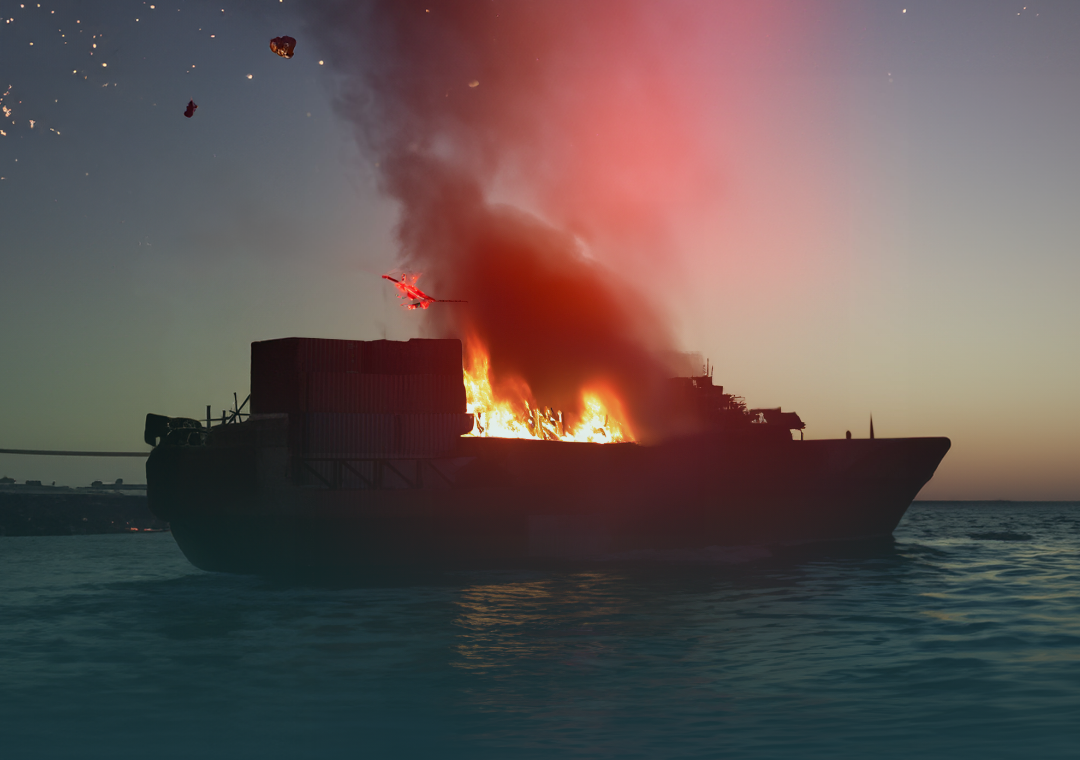
On 3rd July, Stream Marine Technical hosted a webinar in partnership with Ship Management International to address one of the fastest-moving safety risks facing maritime operations. Over 170 industry professionals registered. Throughout the hour-long session, attendance remained consistently high, with delegates asking complex, detailed questions about battery fire behaviour, suppression strategies and crew training requirements.
The webinar brought together maritime professionals, salvage specialists, emergency response experts and training providers to discuss a challenge the industry is only beginning to understand: how electric vehicle fires behave differently at sea and what that means for vessel operations, crew safety and emergency response procedures.
The full recording is now available. It covers warning signs of battery failure, firefighting challenges onboard, emerging technologies for fire suppression and the critical gap between current regulation and operational reality.
What Was Discussed
Warning Signs and Early Intervention
Craig Smith from Stream Marine Technical explained how crews can identify battery failure before thermal runaway occurs. Swelling, unusual heat, chemical odours and physical damage are visible indicators. Early recognition can prevent escalation entirely. Yet most maritime professionals receive no specific training on these warning signs.
Firefighting Challenges at Sea
Lithium-ion fires behave fundamentally differently from conventional maritime fires. Internal chemical reactions generate both fuel and oxygen, meaning external suppression does not stop the fire. Re-ignition can occur hours or days after initial suppression. Water and foam suppression, whilst necessary, require understanding that visibility of flame control is not fire control.
The panelists discussed how confined maritime spaces amplify this challenge. Crew accommodation, vehicle decks and storage areas provide limited escape routes. Smoke spreads quickly through ventilation. Heat and toxic gases affect multiple compartments. A fire that might remain contained in a warehouse escalates far more quickly aboard a vessel.
Emerging Technology and Suppression Systems
John Garner detailed water wall technology now installed on car carrier vessels like ROPAC ships. Boundary cooling and remote suppression offer practical advantages over relying solely on CO2 or foam systems. Some Japanese car carriers have installed foam as a supplementary system to mandated CO2, creating a wall of foam across vehicle decks when activated.
Ruud Plomp added that demonstration of emerging technology will be essential in future maritime training. Understanding how these systems perform in realistic scenarios builds crew confidence and competence.
The Regulatory Gap
Iain Bonehill highlighted the critical gap between current maritime regulation and operational reality. STCW fire safety training remains essential. It effectively covers fuel fires, galley incidents and conventional electrical faults. However, these standards were developed before lithium-ion batteries became widespread on vessels. Training standards have not caught up with technology already present onboard.
The panelists agreed that regulation and training must accelerate to reflect what crews are actually encountering at sea. That means developing specific knowledge about lithium-ion risks to supplement existing fire safety programmes, not replace them.
Why This Matters
The webinar demonstrated that battery fire risk is not theoretical or future-focused. It is happening now. Crews bring personal devices aboard. Ferries transport electric vehicles on enclosed decks. Superyachts store battery-powered tenders in confined spaces. Offshore installations use rechargeable tools daily. The technology is present on modern vessels across multiple sectors.
The challenge is that crews, operators and emergency responders are managing incidents using procedures designed for different hazards. That gap between procedure and reality is where maritime incidents occur.
The webinar audience understood this. The attendance numbers, the detailed questions and the focus on practical application demonstrated industry readiness to address this emerging challenge. The question now is whether training, regulation and equipment adoption will keep pace with operational need.
Watch the Full Recording
About the Panelists
Moderated by: Sean Moloney, Publisher, Ship Management International
Featuring:
Craig Smith, Stream Marine Technical – Alternative Fuels Technical Consultant. Craig brings practical expertise in emerging maritime fuel systems and the associated safety challenges crews need to understand.
Iain Bonehill, Stream Marine Technical – Maritime Training Specialist. Iain’s background spans operational experience at sea and deep knowledge of maritime safety training requirements.
John Garner, JG Maritime Solutions – Emergency Response and Salvage Specialist. John provided detailed insight into how battery fires change salvage operations and what emerging technologies offer.
Ruud Plomp, BlueTack – Maritime Safety Specialist. Ruud contributed expert perspective on suppression systems, testing protocols and practical implementation of new fire management technologies.
What This Means for Maritime Training
This webinar was not a sales pitch for any single product or regulation. It was an honest conversation between industry professionals about an emerging operational challenge. That conversation will continue. The webinar demonstrates that maritime professionals are ready to invest time in understanding battery fire risks because they recognise the hazards crews are encountering now.
For maritime organisations seeking crew development, this recording serves as a foundation for understanding what specialist battery fire awareness training needs to address. It demonstrates the gap between traditional STCW knowledge and the specific understanding battery fires require.
Learn More
Stream Marine Technical delivers Battery Fire Awareness training specifically designed for maritime professionals. The course addresses warning signs, suppression strategies and re-ignition risk in the context of maritime operations.
For more information about battery fire awareness training or crew development requirements:
Phone: +44 (0)141 212 8777
Email: bookings@streammarinetraining.com
Website: streammarinetraining.com