
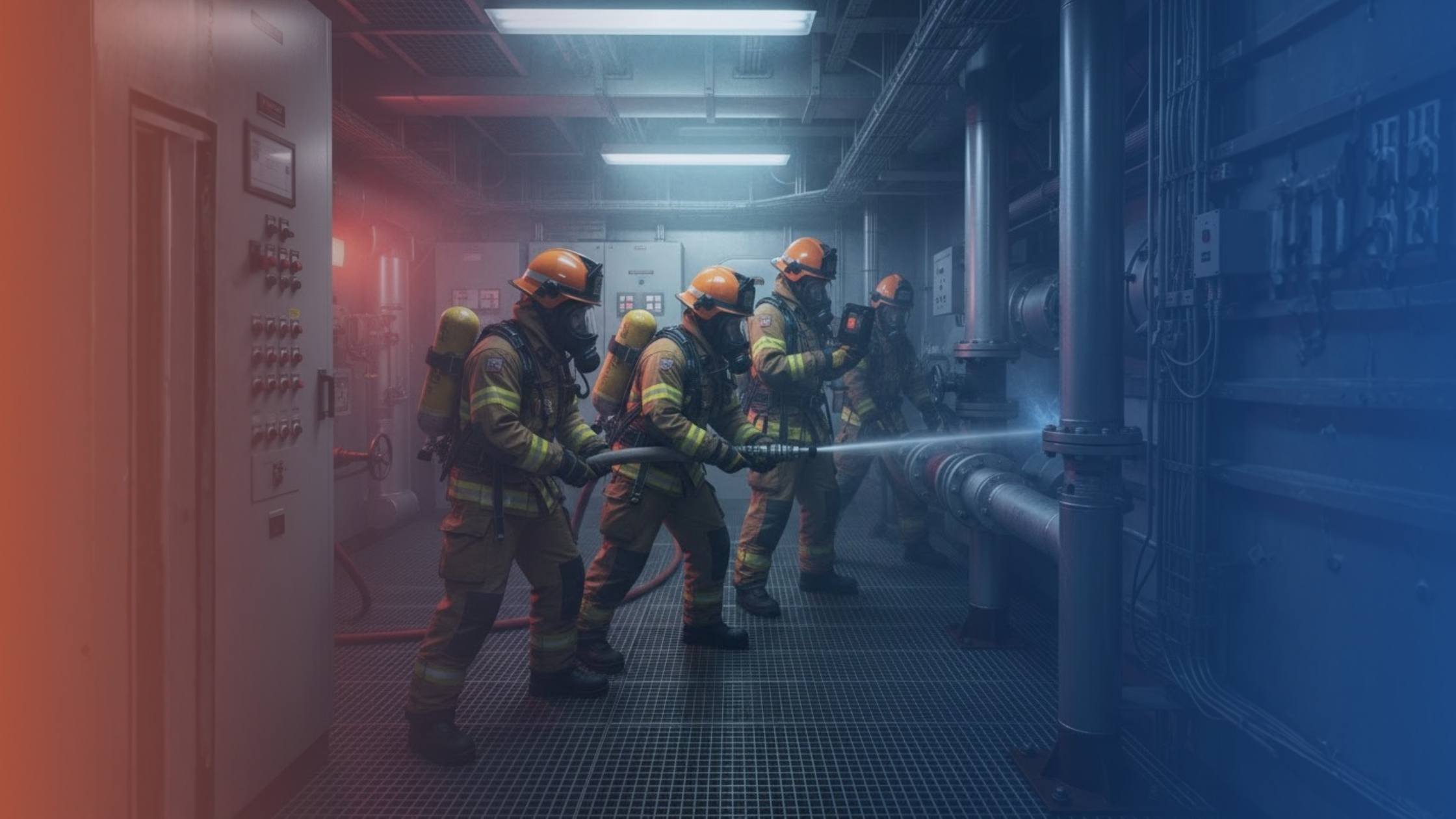
If you’ve trained in marine firefighting over the last decade, your instincts are built around diesel, heavy fuel oil and electrical fires. You know how flame behaves. You know what smoke tells you. You know how boundary cooling and foam attack typically play out in an engine room or accommodation fire.
Alternative fuels are changing that reality.
Methanol, ammonia and hydrogen introduce hazards that behave very differently from conventional marine fuels. Flame visibility changes. Toxic exposure becomes a primary threat. Ventilation strategies shift completely. Some extinguishing methods you’ve relied on for years may no longer apply in the same way.
At Stream Marine Training (SMT), we’re already working with seafarers, officers and emergency response teams who want to understand how their firefighting tactics must evolve. Our firefighting instructors come from operational maritime and emergency services backgrounds, so this is not theoretical discussion. It’s practical, shipboard-focused preparation for what is already happening across the fleet.
This guide looks specifically at how alternative fuels will change emergency response and firefighting tactics onboard, and where current STCW training fits alongside emerging requirements.
Why Traditional STCW Firefighting Training Isn’t Enough for Alternative Fuels
STCW Fire Prevention and Fire Fighting (FPFF) remains the essential foundation for all seafarers. It teaches fire behaviour, detection, containment, use of breathing apparatus, hose handling, boundary cooling and team coordination. For officers with command responsibilities, Advanced Fire Fighting (AFF) builds on that foundation with incident command, tactical decision making and fire control planning.
You can view our FPFF course here:
https://streammarinetraining.com/arlo/events/5-stcw-fire-prevention-and-fire-fighting-fpff/
Traditional STCW firefighting was developed around conventional marine fuels. Diesel, lubricants, hydraulic oils and electrical systems dominate the scenarios. These hazards remain present and STCW firefighting training is still absolutely mandatory and relevant.
The challenge is that alternative fuels introduce behaviours and risks that sit outside traditional firefighting assumptions. Flame visibility may be reduced or absent. Toxic vapours may become the primary threat rather than heat. Extinguishing agents may need different application strategies. Ventilation decisions can have completely different consequences.
For a detailed overview of alternative fuel hazards, refer to our safety considerations guide:
https://streammarinetraining.com/safety-considerations-when-working-with-methanol-ammonia-and-hydrogen-onboard/
This blog focuses on what changes tactically when those fuels ignite or leak onboard.
Methanol Fires: The Invisible Threat
Methanol introduces one of the most unsettling firefighting challenges: flames that can be difficult to see, particularly in daylight.
Methanol fires can be invisible or nearly invisible to the naked eye. A compartment may appear clear whilst still burning. That changes everything about how you approach detection, boundary setting and crew safety.
Picture responding to an engine room fire on a vessel that has recently converted to methanol. A fuel leak has ignited near a pump unit. There is heat. There is vapour. But visible flame is minimal. Crew entering without thermal imaging could step directly into a burning zone.
Thermal imaging cameras become critical for detection and confirmation. Teams must rely more heavily on instrumentation and communication rather than visual flame cues. Boundary cooling still plays a role, but establishing safe approach routes requires careful coordination.
Water-based extinguishing can be effective against methanol fires because methanol is water soluble. The application, however, must be controlled and strategic. Incorrect application may spread burning fuel or push flame into adjacent spaces. Foam compatibility and system design must also be considered depending on vessel configuration.
Communication becomes more complex when teams cannot clearly see flame boundaries. Command must rely on thermal readings, gas detection and continuous updates from entry teams.
Officers responsible for firefighting command can build on their foundation through Advanced Fire Fighting (AFF) training:
https://streammarinetraining.com/arlo/events/4-stcw-advanced-fire-fighting-aff/
At SMT, our instructors emphasise that drills on methanol-fuelled vessels must account for limited flame visibility. Teams need to train for uncertainty rather than relying solely on visual cues.
Ammonia Incidents: Beyond Standard Breathing Apparatus
Ammonia presents a very different type of emergency. The primary threat in many ammonia incidents is not flame but toxicity.
Ammonia is highly toxic and corrosive. Vapour exposure can rapidly incapacitate personnel and damage respiratory systems. It can also corrode equipment and protective gear. In an enclosed shipboard space, this creates a hazard environment that extends beyond conventional fire response.
Standard self-contained breathing apparatus, or SCBA, is designed for smoke and combustion products. Ammonia response may require enhanced respiratory protection and stricter exposure management depending on concentration levels. Emergency teams must also consider chemical protective clothing and decontamination procedures.
Imagine responding to a leak in an ammonia fuel supply line within an engine space. The space may not be fully on fire, yet it is immediately hazardous. Entry decisions must factor in toxicity before heat. Ventilation strategy must prevent vapour spread into accommodation or control spaces. Evacuation zones may be larger than those established for a traditional machinery space fire.
Water spray can be used to help disperse ammonia vapour and protect boundaries, but this must be carefully managed. Run-off and contamination present additional considerations. Decontamination of personnel and equipment becomes part of the emergency response plan.
For context on how alternative fuel training fits into wider certification pathways, read our BIGF and AIGF training guide:
https://streammarinetraining.com/bigf-and-aigf-training-what-deck-and-engine-crew-need-to-know-before-2030/
At SMT, we train crews to understand that ammonia emergencies often combine elements of firefighting and hazardous materials response. Command decisions must adapt accordingly.
Hydrogen Emergencies: Rapid Dispersion and Wide Flammability
Hydrogen introduces a different set of tactical challenges. It disperses rapidly, ignites easily and has an extremely wide flammability range.
This means ignition can occur in spaces that would not normally present a risk with diesel vapours. A small concentration in an enclosed or poorly ventilated space can become hazardous very quickly.
Picture a hydrogen leak within a machinery compartment. The gas rises and disperses rapidly. If it accumulates near overhead structures or within enclosed volumes, ignition risk increases. Traditional firefighting instincts may lead crews to isolate and contain the space, yet ventilation strategy must be carefully managed to avoid creating explosive mixtures.
Hydrogen flames can be difficult to see in certain lighting conditions. Detection systems and thermal imaging become essential for confirming fire presence. Boundary cooling remains relevant, but teams must consider potential re-ignition if gas continues to escape.
Ventilation strategy is perhaps the biggest shift. Conventional fuel fires often require containment and controlled ventilation. Hydrogen incidents may demand rapid dispersion and careful management of ignition sources. Electrical isolation becomes critical. Static discharge that might not affect diesel vapour can ignite hydrogen.
Understanding these dynamics requires additional training beyond standard STCW firefighting. That is where AIGF training becomes important:
https://streammarinetraining.com/arlo/events/135-stcw-advanced-training-for-service-on-ships-using-fuels-covered-within-the-igf-code-aigf/
At SMT, we deliver AIGF training that builds on firefighting foundations and introduces fuel-specific emergency response considerations.
How AIGF Training Bridges the Gap
Advanced Training for Service on Ships Using Fuels Covered Within the IGF Code (AIGF) is a 5-day STCW course designed to prepare crew for alternative fuel operations and emergencies.
It builds directly on the firefighting foundation provided by STCW FPFF and AFF. The goal is not to replace traditional firefighting training but to expand it to include fuel-specific hazards, systems and emergency procedures.
AIGF training covers operational awareness, system design considerations and emergency response principles for low-flashpoint fuels. It introduces crews to the realities of methanol, ammonia and hydrogen operations, including how emergency procedures may differ from conventional fuel vessels.
At SMT, we deliver AIGF training using practical, scenario-based instruction led by instructors with real emergency services and maritime experience. We focus on decision making, communication and safe response rather than theoretical discussion.
You can view our alternative fuel training options here:
https://streammarinetraining.com/courses/cat-74-new-fuel-technology/
For seafarers moving onto vessels using low-flashpoint fuels, combining STCW firefighting training with AIGF is becoming increasingly important.
What Regulatory Changes Are Coming
The regulatory landscape around alternative fuels is evolving. The IMO’s IGF Code already provides a framework for ships using low-flashpoint fuels, and discussions continue around how firefighting and emergency response standards should adapt.
Industry bodies and regulators are examining whether additional firefighting competencies will be required for certain vessel types. Training guidance is expanding, and operators are developing vessel-specific emergency procedures to address new fuel risks.
At present, STCW firefighting requirements remain in place as the global baseline. AIGF training addresses many of the additional competencies needed for alternative fuel operations. Further regulatory developments are anticipated, but exact timelines and requirements are still under discussion.
Preparing early ensures that seafarers remain competitive and ready for vessels already adopting alternative fuels. Waiting until formal regulatory changes are finalised may leave crew playing catch-up.
Preparing Your Emergency Response Skills Now
Traditional STCW firefighting training remains the essential foundation for all seafarers. FPFF and AFF continue to underpin safe emergency response across the global fleet.
What is changing is the operational environment. Alternative fuel vessels are entering service now, not in some distant future. Emergency response teams must be ready to adapt their tactics accordingly.
At SMT, our firefighting instructors bring emergency services experience alongside maritime backgrounds. We approach alternative fuel firefighting with the seriousness it deserves, focusing on practical response, team coordination and safe decision making.
If you are preparing for service on alternative fuel vessels, or already working on one, the next step is straightforward. Maintain your STCW firefighting certification. Build on it with AIGF training. Stay ahead of the regulatory curve.
To discuss course availability or training pathways, contact our team at bookings@streammarinetraining.com or call +44 (0)141 212 8777. We deliver training at our Glasgow facility with realistic fire training environments designed to prepare you for real shipboard emergencies.
Frequently Asked Questions About Alternative Fuels and Firefighting
Does my current STCW firefighting training cover alternative fuels?
Current STCW Fire Prevention and Fire Fighting training focuses primarily on conventional marine fuels. Alternative fuel vessels require additional understanding and procedures covered in AIGF training.
What’s the biggest firefighting challenge with methanol?
Methanol fires can be invisible or nearly invisible in daylight, making detection and boundary establishment extremely difficult without thermal imaging.
Can I use the same firefighting tactics I learned in STCW for ammonia incidents?
No. Ammonia incidents require enhanced respiratory protection beyond standard SCBA and a different approach due to extreme toxicity and corrosive properties.
What is AIGF training and do I need it?
AIGF is Advanced Training for Service on Ships Using Fuels Covered Within the IGF Code. It covers fuel-specific emergency response. If you work or plan to work on alternative fuel vessels, it is becoming essential. View the course here: https://streammarinetraining.com/arlo/events/135-stcw-advanced-training-for-service-on-ships-using-fuels-covered-within-the-igf-code-aigf/
How does hydrogen change shipboard ventilation during emergencies?
Hydrogen’s rapid dispersion and extremely wide flammability range require very different ventilation strategies compared to conventional fuels to prevent explosive mixtures forming.
Will STCW firefighting requirements change for alternative fuels?
IMO and industry bodies are discussing updates to firefighting competencies for alternative fuel vessels. Guidance continues to evolve, and preparing early ensures readiness regardless of when formal changes arrive.
Does Stream Marine Training offer firefighting courses for alternative fuels?
Yes. At SMT we deliver AIGF training alongside traditional STCW firefighting courses, taught by instructors with maritime and emergency services experience.
Do I need Advanced Fire Fighting or just FPFF for alternative fuel vessels?
All crew require appropriate firefighting awareness through FPFF. Officers with command responsibilities need Advanced Fire Fighting. AIGF training adds fuel-specific emergency response for alternative fuel operations.
Are alternative fuel firefighting procedures fully standardised yet?
Not entirely. Procedures continue to evolve as more vessels enter service. Training and vessel-specific emergency plans are developing alongside regulatory guidance.