
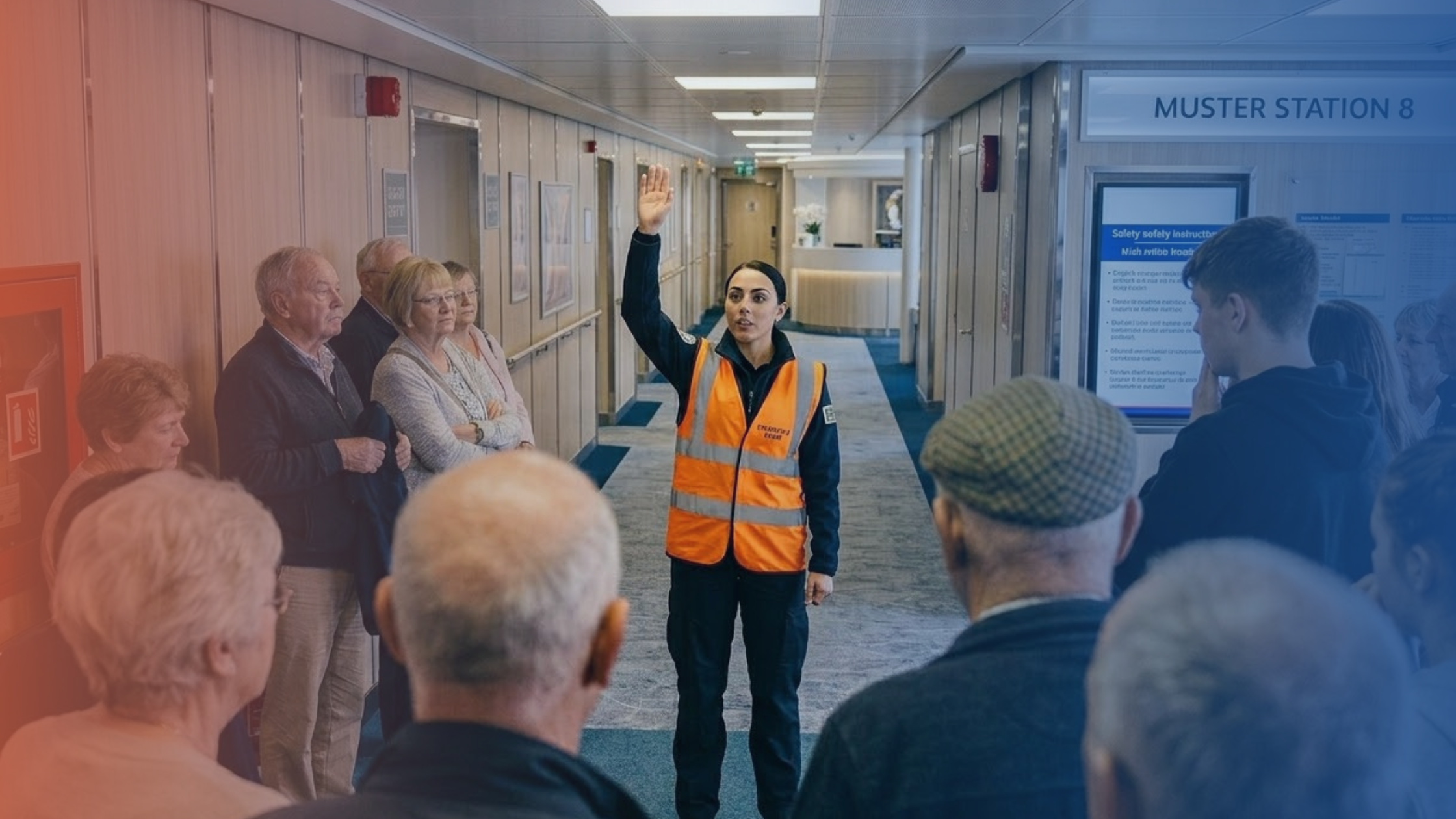
There are moments on passenger ships where everything feels calm. Music is playing, drinks are being served, and people are enjoying themselves without a second thought.
Then something shifts.
It might be a drill or something more serious, but the result is the same. Hundreds, sometimes thousands, of passengers suddenly need direction, reassurance, and clear control at the same time. That is where training stops being theoretical and starts becoming real.
At Stream Marine Training in Glasgow, we see this realisation happen quickly. Delegates often arrive expecting something straightforward, maybe even routine. What they experience instead is something far more grounded. This training is built around people, and people rarely behave the way procedures suggest they will.
Picture a muster station holding 2,000 passengers.
Some don’t speak English. Others are elderly or unsure where to go. A few begin to panic. One passenger insists on returning to their cabin for medication, another refuses to leave their luggage behind, and somewhere in the middle a family becomes separated.
Add pressure, noise, and uncertainty.
That is the environment this training prepares you for.
Not Covered by Basic STCW
A lot of people assume that once they’ve completed their STCW Basic Safety Training, they’re fully prepared for life at sea.
That’s only part of the picture.
Basic STCW gives you the foundation. Survival, firefighting, first aid, and safe working practices. It teaches you how to respond to emergencies from a crew perspective. If you have not completed it yet, you can view it here:
https://streammarinetraining.com/arlo/events/61-stcw-basic-safety-training-week-bsw/
Passenger vessels introduce a different layer entirely.
You are now responsible for people who may not understand procedures, who may react emotionally, and who may not follow instructions straight away. That changes how emergencies unfold and how they need to be managed.
Understanding Behaviour Under Pressure
Here’s where things become less predictable.
In real situations, passengers do not move as one. They react individually, based on fear, confusion, language barriers, or simply not knowing what is happening.
Crowd Management training, formally known as STCW Proficiency in Crowd Management (CM) under Regulation V/2, focuses on recognising and managing these behaviours.
At SMT, we approach this through practical discussion and realistic scenarios rather than just theory. Delegates learn how to assess a situation quickly, recognise stress levels in both themselves and others, and respond in a way that keeps control without escalating tension.
People hesitate. They question instructions. Some freeze entirely, whilst others act too quickly.
Occasionally, all of that happens at once.
And yes, that includes the passenger who refuses to move without their belongings.
Communication Changes Everything
On a passenger vessel, communication is rarely straightforward.
You are dealing with different languages, different expectations, and different reactions to authority. In calm situations, that diversity adds to the experience. In an emergency, it can slow everything down.
Clear communication becomes critical.
Not just what you say, but how you say it. Tone, body language, and timing all play a role in how instructions are received.
At Stream Marine Training, we place a strong emphasis on this. Many of our instructors have real experience at sea or within emergency services, so the guidance you receive is based on situations they have personally managed.
Delegates practise delivering instructions clearly, adapting their approach, and stepping in when situations begin to escalate.
Sometimes that means repeating yourself. Sometimes it means simplifying everything down to a few clear words.
What You Actually Learn
The course itself is short, but it is focused.
Delivered over around half a day at our Paisley facility near Glasgow Airport, it concentrates on the skills that matter most when dealing with passengers in an emergency.
That includes understanding how to:
- Locate and use essential safety and emergency equipment onboard
- Communicate effectively with passengers during high-pressure situations
- Demonstrate the use of personal life-saving appliances
- Support the vessel’s safety procedures and muster plans
There is also a short assessment at the end to confirm your understanding, in line with MNTB guidelines.
It is not about memorising content. It is about understanding how to apply it.
Muster Stations in the Real World
On paper, muster stations are structured and controlled environments.
In reality, they can become unpredictable very quickly.
Passengers arrive at different times, some unsure where they should be. Movement can slow if bottlenecks form. Individuals with reduced mobility may need assistance, whilst others may become frustrated or confused.
The role of crew is to manage that movement, maintain calm, and ensure procedures are followed without creating panic.
At SMT, we focus on these real-world challenges. The aim is to prepare delegates for what actually happens, not just what should happen.
Because knowing the process is only part of it.
Applying it under pressure is what matters.
Why It Matters for Getting Hired
Cruise lines such as Royal Caribbean, Disney Cruise Line, and Cunard expect crew to hold this certification before or shortly after joining.
Ferry operators across the UK and Europe follow the same approach.
It is not a bonus qualification. It is a requirement for anyone working with passengers.
We often see delegates at Stream Marine Training taking this course before applying for roles, simply to strengthen their position. It shows awareness of the job and readiness to step into it.
If you are looking at the bigger picture of your training, you can explore the full STCW pathway here:
https://streammarinetraining.com/courses/cat-2-stcw-courses/
How It Connects to Other Training
Crowd Management is closely linked to Crisis Management and Human Behaviour training.
The difference is in the level of responsibility.
Crowd Management focuses on directing passengers and maintaining control during an incident. Crisis Management looks at decision-making and leadership across the vessel.
At SMT, we help delegates understand how these fit together, rather than treating them as separate requirements.
Not Just Cruise Ships
Although often associated with large cruise vessels, this training applies across a range of passenger environments.
Ferries. Ro-pax vessels. Yachts.
The scale may change, but the responsibility remains the same.
If you are considering yacht roles, you can explore relevant pathways here:
https://streammarinetraining.com/courses/cat-76-yacht-training/
Different environments. Same expectation.
What Stays With You
This is not the most physically demanding course you will take.
But it is one that changes how you see people.
You begin to notice behaviour patterns in crowded spaces. How quickly calm can shift into confusion. How small actions can influence larger groups.
Airports feel different. Train stations feel different.
You start paying attention in a way you didn’t before.
There is no dramatic ending to this course.
No big moment where everything suddenly clicks.
Instead, there is a steady shift in understanding. You walk in thinking it is about procedures. You leave recognising it is about people.
Passenger vessels rely on crew who can stay calm, communicate clearly, and take control when needed. That ability is built through preparation, not guesswork.
At Stream Marine Training in Glasgow, that preparation is shaped by instructors who have been there themselves. The focus is always on making training relevant, practical, and grounded in real experience.
If you are considering this course or want to understand how it fits into your career at sea, you can contact the team at bookings@streammarinetraining.com or call +44 (0)141 212 8777.
Because when things change onboard, preparation is what holds everything together.
FAQs: Crowd Management Training
Is crowd management the same as basic STCW training?
No. Basic STCW covers core safety modules such as firefighting, survival, and first aid. Crowd Management is an additional requirement specifically for those working on passenger ships.
Do I need crowd management training for cruise ship jobs?
In most cases, yes. Cruise lines such as Royal Caribbean, Disney Cruise Line, and Cunard require it, as do many ferry operators. It is often expected before joining or completed early in employment.
How long does crowd management training take?
Most courses are delivered over one to two days. At SMT in Glasgow, the focus is on practical understanding rather than simply covering theory.
Does crowd management certification expire?
No. STCW Crowd Management certification does not require refresher training, unlike modules such as Personal Survival Techniques or Fire Prevention and Fire Fighting.
What’s the difference between crowd management and crisis management?
Crowd Management focuses on directing and assisting passengers during an incident. Crisis Management is aimed at those in leadership roles and covers decision-making, coordination, and overall control of the situation.
Can I take crowd management training before getting a cruise ship job?
Yes, and many people do. Having the certification in advance can make your application stronger and show that you understand the expectations of working on passenger vessels.
Is crowd management training difficult?
It is not physically demanding, but it does require attention and engagement. The challenge comes from understanding human behaviour and applying that knowledge in realistic situations.